Rust Framework Implements Durable SQLite-Backed Cells
Cellule: a Rust framework for durable SQLite-backed Cells with fenced ownership and exact recovery. - crabbuild/cellule Cellule Cellule is an embedded Rust framework for distributed, SQLite-backed Cells . An application defines typed modules and Cell topology; Cellule runs commands through a fenced owner, publishes durable outcomes, and restores exact state.…
GitHub - crabbuild/cellule: Cellule: a Rust framework for durable SQLite-backed Cells with fenced ownership and exact recovery.
Cellule
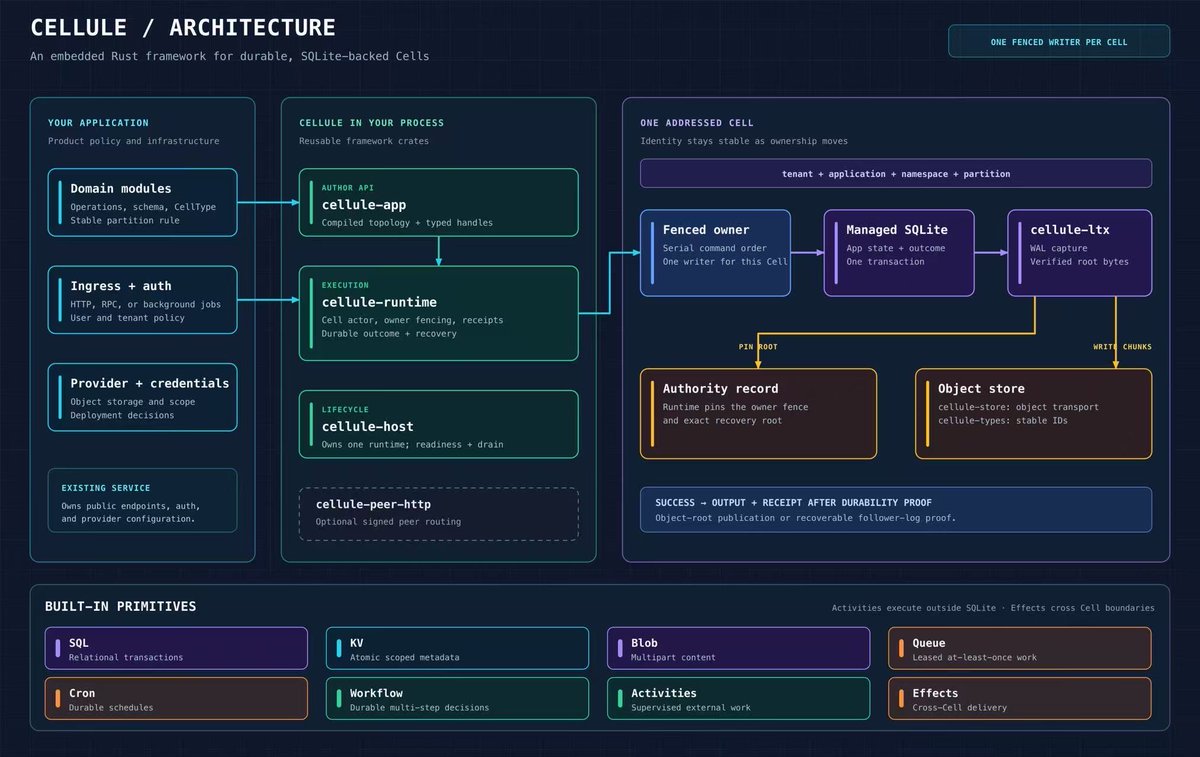
Cellule is an embedded Rust framework for distributed, SQLite-backed Cells . An application defines typed modules and Cell topology; Cellule runs commands through a fenced owner, publishes durable outcomes, and restores exact state. The application owns HTTP ingress, authorization, credentials, and deployment.
For a visual introduction to a Cell, its components, and the smallest integration path, see Cellule at a glance .
The Cell model
An application compiles modules (what a Cell can do) and Cell types (which namespace, role, and partition rule each module uses). At runtime, a target selects one Cell. Its identity stays stable when a different node takes ownership:
tenant + application + namespace + partition | v stable Cell ID | v one fenced writer at a time | v managed SQLite: state + request outcomes
The fenced owner handles commands for that Cell. Authority records the current owner and pins the published root used for object-store recovery. LTX captures SQLite changes into verified, immutable objects. Your service still chooses tenants, authorizes callers, and supplies storage credentials and endpoints.
Pick a Cell boundary
One command changes one Cell, so place state that must commit together behind one target. A Cell type declares how targets are partitioned:
The SQL lesson below uses one fixed shard. A namespace, role, partition rule, or shard-count change can alter persisted identity and routing; treat it as a reviewed application change. The topology guide covers the exact rules. Work that spans Cells uses durable Effects and an idempotent destination inbox.
Start locally
Use Rust 1.97 or newer . From the workspace root, run these local examples; they use temporary SQLite files and in-memory object storage:
cargo run -p cellule-app --example basic --locked cargo run -p cellule-app --example sql --locked cargo run -p cellule-app --example blob --locked cargo run -p cellule-app --example workflow --locked cargo run -p cellule-app --example schedules --locked
Together these paths exercise all eight primitives through typed handles. No cloud credentials are needed. Follow the step-by-step quickstart for expected output and a local recovery test. Each source file starts with a run command and an ASCII outline of its path.
Follow one complete application path
The runnable SQL example contains the complete local setup. It declares a SQL module and migration, compiles an application, provisions a catalog entry and fenced owner, bootstraps a managed Cell, invokes it through a typed handle, checks the observed row, and drains the runtime. The snippets below are from that compiled example; keep the full source open if you are copying them into an application.
The path is a short sequence you can trace in sql.rs :
Describe Orders : SQL schema, namespace, and stable command/query IDs.
Compile OrdersApp : bind the module to a CellType and freeze the descriptor and registry.
Provision a CellTarget , catalog entry, and fenced owner.
Start managed SQLite and an LTX replica for that Cell.
Commit one parameterized SQL batch with a stable request identity; get its output and receipt after the durability gate.
Observe with query(Some(receipt), ...) ; check the committed row.
Drain the runtime on either success or failure.
describe -> compile -> provision -> start -> commit -> observe -> drain (request ID) (receipt)
The example assembles a local owner and in-memory object store so that every step can run on one machine. A serving service assembles its provider, owner routing, and node lifecycle separately; see the framework guide .
Declare the application
Orders and ORDERS are defined in the full source. Their module descriptor includes the schema migration and operation contracts used here:
struct OrdersApp ; impl CellApplication for OrdersApp { const NAME : & ' static str = "orders-example" ; fn register ( builder : & mut cellule_app :: ApplicationBuilder ) -> cellule_runtime :: Result < ( ) > { builder . register ( Orders ) ? ; builder . cell_type ( CellType :: new ( Orders :: NAME , "orders" , ORDERS , CatalogRole :: Sql , 1 , ) ? ) ? ; Ok ( ( ) ) } }
CellApplication::compile checks the module and topology before any Cell starts. Stable namespace IDs, partition rules, schema versions, and operation IDs are compatibility contracts; see the API guide before changing them.
Commit and verify a receipt-bound read
This function is the example's complete application-level operation. The caller obtains SqlCell<Orders> from ApplicationHandle::<OrdersApp> after bootstrapping the Cell:
async fn commit_and_read_order ( sql : & SqlCell < Orders > ) -> ExampleResult < i64 > { let now_ms = i64 :: try_from ( SystemTime :: now ( ) . duration_since ( UNIX_EPOCH ) ? . as_millis ( ) ) ? ; let committed = sql . batch ( MutationIdentity { request_id : RequestId :: from_bytes ( [ 6 ; 16 ] ) , issued_at_ms : now_ms , expires_at_ms : now_ms + 60_000 , } , SqlBatch { statements : vec ! [ SqlStatement { sql : "INSERT INTO orders (id, total_cents) VALUES (?1, ?2)" . into ( ) , parameters : vec! [ SqlValue :: Integer ( ORDER_ID ) , SqlValue :: Integer ( ORDER_TOTAL_CENTS ) , ] , } ] , } , ) . await ? ; // The receipt requires the query to observe this published command. let observed = sql . query ( Some ( committed . receipt ) , SqlBatch { statements : vec ! [ SqlStatement { sql : "SELECT total_cents FROM orders WHERE id = ?1" . into ( ) , parameters : vec! [ SqlValue :: Integer ( ORDER_ID ) ] , } ] , } , ) . await ? ; let [ result ] = observed . output . as_slice ( ) else { return Err ( Error :: Control ( "expected one order query result" ) . into ( ) ) ; } ; let [ row ] = result . rows . as_slice ( ) else { return Err ( Error :: Control ( "expected one order row" ) . into ( ) ) ; } ; let [ SqlValue :: Integer ( total_cents ) ] = row . as_slice ( ) else { return Err ( Error :: Control ( "expected an integer order total" ) . into ( ) ) ; } ; if * total_cents != ORDER_TOTAL_CENTS { return Err ( Error :: Control ( "published order total differs" ) . into ( ) ) ; } Ok ( * total_cents ) }
The request ID stays the same for retries of this command; a new logical command needs a new ID. batch returns a Committed value only after the durability gate. Passing Some(committed.receipt) to query requires the read to observe that committed position. The function checks the actual row instead of treating a successful transport call as proof of application behavior.
Choose a primitive
Every primitive uses the same Cell owner, durable request outcome, publication gate, and receipt. Choose by the shape of work, then use the typed capability from ApplicationHandle :
Primitives can be combined without treating multiple Cells as one SQL transaction. Two examples show where background supervisors enter the path:
Recurring delivery: Cron Cell -> due tick -> durable Effect -> supervisor -> destination inbox -> destination Cell
External workflow step: Workflow Cell -> Activity intent -> supervisor -> external work Workflow Cell <- recorded completion <- supervisor <- result
The service installs and drains those supervisors. The destination must handle repeated delivery idempotently; a Queue consumer must likewise validate its lease and make external work safe to repeat.
The example map explains how each runnable path works, including the Blob upload , Workflow activity , and Cron effect delivery . The application integration suite also exercises all eight primitives and recovery. Read the primitive guide and API guide for method details and failure behavior. Cross-Cell work uses effects and inboxes; it is not one transaction across Cells.
Why a successful reply survives recovery
A command stores its state change and outcome in one SQLite transaction. On the object-store path, the owner prepares verified LTX bytes and pins the exact root through fenced authority compare-and-swap before replying. A configured follower-log path can acknowledge after recoverable follower proof, with object publication following. Recovery selects the authority-pinned root and verifies every required chunk; a bucket listing cannot choose state. If a response is lost, resolve the original request ID before retrying. See architecture and runtime execution .
Reply received -> use the output and receipt Reply lost -> keep the original request identity -> resolve its recorded outcome |-- committed: use the recorded output and receipt |-- absent: retry the same prepared command if still valid `-- unknown or expired: investigate; do not invent a new ID
An owner-ordered query is the default. A read can require a minimum receipt from that same Cell . An explicitly selected replica must prove that it has reached the minimum or return a lag/unavailable error; it does not silently fall back to the owner. See read policies and uncertain commands .
From the local lesson to a service
The examples supply a temporary database, in-memory objects, and a local fenced owner. To serve requests across nodes, the application must:
Compile the same modules and Cell topology used by its typed clients.
Choose and probe an object provider, then enroll a node with a live lease and install the facilities it declares as required.
Authenticate and authorize public requests before selecting tenant and Cell targets; install a peer receiver if remote owner routing is needed.
Supervise Activities, Effects, and scheduled maintenance that the service uses, and drain accepted work before withdrawing the node session.
The framework integration guide walks through readiness, peer boundaries, replicas, and shutdown. The local examples demonstrate API and durability mechanics; provider and process qualification have separate evidence requirements .
Go deeper
The workspace layers are cellule-types → cellule-store → cellule-ltx → cellule-runtime → cellule-app → cellule-host ; the optional cellule-peer-http adapter uses runtime contracts. Contributing lists local checks, and the qualification guide separates local tests from provider and production evidence. The dated verification report and performance evidence describe their recorded revisions and environments.
License
The Cellule workspace crates are licensed under the Apache License 2.0 . The adapted cellule-ltx source retains upstream attributions and a separate BSD-3-Clause license for its included LZ4 block implementation.
I became a big fan of cell-based architecture while working on S3 at AWS. At S3 scale, you can’t treat the entire service as one giant system. You partition it into cells, give each cell its own capacity(data plane) and clear ownership(control plane), and contain failures so a problem in one cell doesn’t bring down everything else. Cellularization brings several important benefits: 1. Scale by adding cells 2. Recover and operate cells independently 3. Limit the blast radius of failures 4. Make capacity and ownership more explicit But it also introduces real engineering challenges: routing requests to the…
Read full post
right cell, balancing load across cells, moving or rebalancing data, and scaling cells up and down safely. Now I’m building my own cell-based runtime Cellule - https://t.co/5MMYkE1pc2 - around the same ideas, heavily inspired by https://t.co/h2WP2OnGes and https://t.co/B8OQCsbo7Y, but with a much smaller scope. Cellule is a Rust library that can be embedded directly into a cell-based application with minimal dependencies—ideally, just an object store. It provides the basic building blocks for: - Key-value storage - SQL - Blob - Queues - Workflows - Schedulers - Effects for cross-cell coordination Applications built on top of it should be deployable as a single binary, keeping operations and deployment as simple as possible. I’ve already built a few very different systems on top of Cellule, including a DynamoDB-compatible database server and a Git hosting server. crab-http-server is being built on it too. I’ll write about these examples, and what worked and didn’t, in a follow-up blog post.
Original title: GitHub - crabbuild/cellule: Cellule: a Rust framework for durable SQLite-backed Cells with fenced ownership and exact recovery.
Samuel Times preserves the original link so every selection remains auditable.