EIA Says China Holds Largest Strategic Oil Inventory
Today in Energy Recent articles Browse by tag liquid fuels natural gas electricity oil/petroleum production/supply crude oil consumption/demand generation prices map states exports/imports international coal renewables weather forecasts/projections gasoline capacity steo (short-term energy outlook) liquid fuels natural gas electricity oil/petroleum production/supply crude oil consumption/demand generation prices map…

China, the United States, and Japan hold most strategic oil inventories in 2025 - U.S. Energy Information Administration (EIA)
Today in Energy
Recent articles
Browse by tag liquid fuels natural gas electricity oil/petroleum production/supply crude oil consumption/demand generation prices map states exports/imports international coal renewables weather forecasts/projections gasoline capacity steo (short-term energy outlook)
liquid fuels
natural gas
electricity
oil/petroleum
production/supply
crude oil
consumption/demand
generation
prices
map
states
exports/imports
international
coal
renewables
weather
forecasts/projections
gasoline
capacity
steo (short-term energy outlook)
Prices
Archive
About
China, the United States, and Japan hold most strategic oil inventories in 2025
Data source: U.S. Energy Information Administration, Short-Term Energy Outlook (STEO), March 2026 Note: Other estimates derived from the International Energy Agency, China National Bureau of Statistics, Vortexa Analytics, Kayrros, Kpler, Argus Media, and Global Trade Tracker. In the 1970s, the United States and other OECD countries established strategic oil stocks aimed at mitigating the impact of supply disruptions. In March 2026, the United States, along with other members of the International Energy Agency, agreed to a coordinated emergency release of strategic oil stocks following the effective closure of the Strait of Hormuz. In this article, we examine strategic global oil inventory levels as of December 2025, before the coordinated emergency release. We plan to update our assessment of inventories periodically in our Short-Term Energy Outlook beginning in May 2026. We estimate that as of December 2025, the three largest strategic oil inventories were held by China, which added large volumes to its strategic oil inventories in 2025; the United States; and Japan. Other significant strategic inventories are held by countries in OECD Europe, the Middle East, and Asia. Given the lack of transparent data on strategic inventories in most countries, we take a conservative approach in estimating these volumes. For countries without a specified strategic petroleum reserve, we define strategic inventories as those owned by governments or national oil companies (NOCs) and, for a few countries, only inventories held in on-land storage. In addition, we do not include inventories in commercial, floating, or underground storage facilities, except for in China, for which we define strategic inventories as including commercial inventories. While some countries, like Japan , also require companies to hold barrels in commercial inventories for strategic purposes, we only include government-owned inventories or those held by government-owned NOCs for this estimation. We also limit our analysis to the 10 countries with the largest estimated current strategic oil inventories and on-land storage capacity, which together equal about 70% of global totals. These estimates do not take into account the coordinated emergency release in March 2026 by member countries of the International Energy Agency following Iran’s de facto closure of the Strait of Hormuz. United States The U.S. Strategic Petroleum Reserve (SPR), established in December 1975 , has a full storage capacity of 714 million barrels of crude oil. In December 2025, the SPR held 413 million barrels. SPR stocks increased to more than 415 million barrels in March, ahead of the coordinated release , and were about 409 million barrels as of April 10, 2026. The SPR is separate from the more than 400 million barrels of commercial crude oil inventories in the United States. China We estimate that China added an average of 1.1 million barrels per day of crude oil to strategic oil inventories in 2025, which reached nearly 1.4 billion barrels as of December 2025. Prior to the Iran conflict, preliminary government data indicate that China has continued building inventories in 2026. China does not report data on its oil inventories, so we estimated China’s inventories based on imports, exports, refining, and oil inventory data from third-party and official sources. For this analysis, we consider both China’s government-held and commercial inventories to be part of strategic oil inventories, based on reports that China’s NOCs have been directed since 2024 to add emergency oil to commercial stockpiles , which effectively act as a second source of strategic inventories. Data source: U.S. Energy Information Administration, Short-Term Energy Outlook (STEO), March 2026 Note: Other estimates derived from the International Energy Agency, China National Bureau of Statistics, Vortexa Analytics, Kayrros, Kpler, Argus Media, and Global Trade Tracker. While we assume that both commercial and government-held crude oil inventories in China are part of strategic oil inventories, we estimate that government-held inventories in China averaged about 360 million barrels in December 2025, which is similar to the U.S. SPR level of nearly 414 million barrels during the same time period. Commercial crude oil inventories in China, which include inventories held at refineries, have grown to an estimated 1 billion barrels as of December 2025, compared with 411 million barrels held commercially in the United States. OECD Asia and Europe Japan holds the third-largest strategic oil inventories, reaching 263 million barrels in government-held inventories as of December 2025. These figures do not include international joint stockpiling inventories or commercial inventories held for strategic purposes pursuant to Japanese law. Japan’s Oil Stockpiling Act requires industry to hold 70 days of demand—approximately 220 million barrels—in addition to the 90-day strategic reserve overseen by the government. According to the International Energy Agency, OECD Europe held an estimated 179 million barrels in government inventories as of December 2025. South Korea also holds substantial strategic oil inventories, averaging 79 million barrels during the same period in 2025. Other non-OECD countries Apart from India, strategic inventory levels for the non-OECD countries included in our analysis (Saudi Arabia, the UAE, and Iran) are difficult to determine. It is also difficult to distinguish between storage facilities used for commercial and strategic purposes. Given these limitations, we estimate current strategic inventories for Saudi Arabia, UAE, and Iran based on the December 2025 average refinery and commercial inventories reported by Vortexa and Kpler. Saudi Arabia held an average of 82 million barrels in on-land storage as of December 2025. These estimates do not include inventories reportedly held by Saudi Arabia in leased crude oil storage sites in South Korea and in Okinawa and the Kiire terminal in Japan. The UAE held an average of 34 million barrels of on-land oil inventories as of December 2025. The UAE also maintains substantial underground storage in Fujairah, the capacity and inventory of which is unknown, and is seeking to increase storage capacity at the location. The UAE also reportedly leases storage sites at the Yeosu port in South Korea , the Kiire terminal in Japan, and the Mangalore storage facility in India . Iran held an average of 71 million barrels of on-land oil as of December 2025. Iran reportedly holds crude oil in bonded storage in China , although its current inventory levels are unknown and not estimated here. According to Indian Strategic Petroleum Reserve Ltd. (ISPRL), India had 21.4 million barrels of crude oil stored in its SPR as of March 2025. India also had an additional 3 million barrels of crude oil stored at its Mangalore site for the Abu Dhabi National Oil Company (ADNOC) that is not considered part of India’s strategic reserve. An agreement between ADNOC and ISPRL allows ADNOC to use the site for commercial storage as long as 50% of capacity (approximately 6 million barrels) is available for ISPRL’s strategic use. India has also been exploring the possibility of adding storage outside of the country for its own oil and held discussions with Oman about leasing space to store 5 million barrels last year . Principal contributors: Sean Hill, Eric Han, Jonathan Russo Tags: China , United States , Japan , international , inventories/stocks , oil/petroleum , crude oil , liquid fuels
In the 1970s, the United States and other OECD countries established strategic oil stocks aimed at mitigating the impact of supply disruptions. In March 2026, the United States, along with other members of the International Energy Agency, agreed to a coordinated emergency release of strategic oil stocks following the effective closure of the Strait of Hormuz.
In this article, we examine strategic global oil inventory levels as of December 2025, before the coordinated emergency release. We plan to update our assessment of inventories periodically in our Short-Term Energy Outlook beginning in May 2026.
We estimate that as of December 2025, the three largest strategic oil inventories were held by China, which added large volumes to its strategic oil inventories in 2025; the United States; and Japan. Other significant strategic inventories are held by countries in OECD Europe, the Middle East, and Asia.
Given the lack of transparent data on strategic inventories in most countries, we take a conservative approach in estimating these volumes. For countries without a specified strategic petroleum reserve, we define strategic inventories as those owned by governments or national oil companies (NOCs) and, for a few countries, only inventories held in on-land storage. In addition, we do not include inventories in commercial, floating, or underground storage facilities, except for in China, for which we define strategic inventories as including commercial inventories. While some countries, like Japan , also require companies to hold barrels in commercial inventories for strategic purposes, we only include government-owned inventories or those held by government-owned NOCs for this estimation.
We also limit our analysis to the 10 countries with the largest estimated current strategic oil inventories and on-land storage capacity, which together equal about 70% of global totals. These estimates do not take into account the coordinated emergency release in March 2026 by member countries of the International Energy Agency following Iran’s de facto closure of the Strait of Hormuz.
United States The U.S. Strategic Petroleum Reserve (SPR), established in December 1975 , has a full storage capacity of 714 million barrels of crude oil. In December 2025, the SPR held 413 million barrels. SPR stocks increased to more than 415 million barrels in March, ahead of the coordinated release , and were about 409 million barrels as of April 10, 2026.
The SPR is separate from the more than 400 million barrels of commercial crude oil inventories in the United States.
China We estimate that China added an average of 1.1 million barrels per day of crude oil to strategic oil inventories in 2025, which reached nearly 1.4 billion barrels as of December 2025. Prior to the Iran conflict, preliminary government data indicate that China has continued building inventories in 2026.
China does not report data on its oil inventories, so we estimated China’s inventories based on imports, exports, refining, and oil inventory data from third-party and official sources. For this analysis, we consider both China’s government-held and commercial inventories to be part of strategic oil inventories, based on reports that China’s NOCs have been directed since 2024 to add emergency oil to commercial stockpiles , which effectively act as a second source of strategic inventories.
While we assume that both commercial and government-held crude oil inventories in China are part of strategic oil inventories, we estimate that government-held inventories in China averaged about 360 million barrels in December 2025, which is similar to the U.S. SPR level of nearly 414 million barrels during the same time period. Commercial crude oil inventories in China, which include inventories held at refineries, have grown to an estimated 1 billion barrels as of December 2025, compared with 411 million barrels held commercially in the United States.
OECD Asia and Europe Japan holds the third-largest strategic oil inventories, reaching 263 million barrels in government-held inventories as of December 2025. These figures do not include international joint stockpiling inventories or commercial inventories held for strategic purposes pursuant to Japanese law. Japan’s Oil Stockpiling Act requires industry to hold 70 days of demand—approximately 220 million barrels—in addition to the 90-day strategic reserve overseen by the government.
According to the International Energy Agency, OECD Europe held an estimated 179 million barrels in government inventories as of December 2025.
South Korea also holds substantial strategic oil inventories, averaging 79 million barrels during the same period in 2025.
Other non-OECD countries Apart from India, strategic inventory levels for the non-OECD countries included in our analysis (Saudi Arabia, the UAE, and Iran) are difficult to determine. It is also difficult to distinguish between storage facilities used for commercial and strategic purposes. Given these limitations, we estimate current strategic inventories for Saudi Arabia, UAE, and Iran based on the December 2025 average refinery and commercial inventories reported by Vortexa and Kpler.
Saudi Arabia held an average of 82 million barrels in on-land storage as of December 2025. These estimates do not include inventories reportedly held by Saudi Arabia in leased crude oil storage sites in South Korea and in Okinawa and the Kiire terminal in Japan.
The UAE held an average of 34 million barrels of on-land oil inventories as of December 2025. The UAE also maintains substantial underground storage in Fujairah, the capacity and inventory of which is unknown, and is seeking to increase storage capacity at the location. The UAE also reportedly leases storage sites at the Yeosu port in South Korea , the Kiire terminal in Japan, and the Mangalore storage facility in India .
Iran held an average of 71 million barrels of on-land oil as of December 2025. Iran reportedly holds crude oil in bonded storage in China , although its current inventory levels are unknown and not estimated here.
According to Indian Strategic Petroleum Reserve Ltd. (ISPRL), India had 21.4 million barrels of crude oil stored in its SPR as of March 2025.
India also had an additional 3 million barrels of crude oil stored at its Mangalore site for the Abu Dhabi National Oil Company (ADNOC) that is not considered part of India’s strategic reserve. An agreement between ADNOC and ISPRL allows ADNOC to use the site for commercial storage as long as 50% of capacity (approximately 6 million barrels) is available for ISPRL’s strategic use. India has also been exploring the possibility of adding storage outside of the country for its own oil and held discussions with Oman about leasing space to store 5 million barrels last year .
Principal contributors: Sean Hill, Eric Han, Jonathan Russo
Tags: China , United States , Japan , international , inventories/stocks , oil/petroleum , crude oil , liquid fuels
Petroleum & Other Liquids
Crude oil, gasoline, heating oil, diesel, propane, and other liquids including biofuels and natural gas liquids.
Natural Gas
Exploration and reserves, storage, imports and exports, production, prices, sales.
Electricity
Sales, revenue and prices, power plants, fuel use, stocks, generation, trade, demand & emissions.
Coal
Reserves, production, prices, employment and productivity, distribution, stocks, imports and exports.
Nuclear & Uranium
Uranium fuel, nuclear reactors, generation, spent fuel.
Renewable & Alternative Fuels
Includes hydropower, solar, wind, geothermal, biomass and ethanol.
EIA Survey Forms
Forms EIA uses to collect energy data including descriptions, links to survey instructions, and additional information.
Total Energy
Comprehensive data summaries, comparisons, analysis, and projections integrated across all energy sources.
Monthly Energy Review
Consumption & Efficiency
Energy use in homes, commercial buildings, manufacturing, and transportation.
Residential Energy Consumption Survey (RECS)
Commercial Buildings Energy Consumption Survey (CBECS)
Manufacturing Energy Consumption Survey (MECS)
U.S. States
State energy information, including overviews, rankings, data, and analyses.
International
International energy information, including overviews, rankings, data, and analyses.
Environment
Greenhouse gas data, voluntary reporting, electric power plant emissions.
U.S. Energy-Related Carbon Dioxide Emissions
Energy-Related Carbon Dioxide Emissions at the State Level
Analysis and Projections
RT @MartinLZinn: Just as Beijing’s huge stimulus programme helped the West recover from the 2008 financial crisis, once again China is prov…
RT @maxotte_says: Arnaud Bertrand hat immer sehr gute geopolitische Analysen.
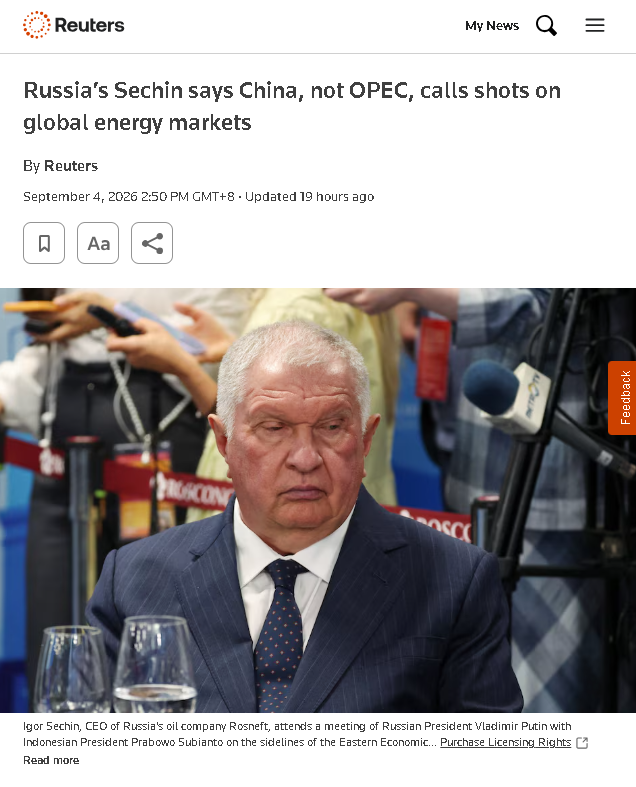
This hasn't been talked about much but it may be one of the most consequential revelations of the US's war on Iran: the fact that China has effectively replaced OPEC as the global price setter for oil. It isn't me saying it but Igor Sechin, CEO of Rosnef, the largest oil producer in Russia - itself a member of OPEC+ (https://t.co/ckinOaHzJ7) And Sechin isn't alone in saying so: many Western analysts - such as Javier Blas, Bloomberg's top energy analyst - are essentially saying the same thing (see https://t.co/cpcCKLdMCv) How so? Well, China has demonstrated during the Iran war an extraordinary ability to…
Read full post
simply walk away from the market and slash its oil imports by millions of barrels per day - during a months on end. At peak, they slashed imports by 5.5 million barrels per day, the equivalent of India's total consumption. They can, quite literally, switch an entire India's worth of demand on and off, at will. This is mainly because they have immense strategic oil reserves, estimated to stand at 1.4 billion barrels (https://t.co/jyTb2Srcnz) - 4 times bigger than the US's (the world's second largest inventory). In a nutshell, prices being, as everyone knows, set by supply and demand, China now controls the demand side in a bigger way than OPEC controls the supply side. So, as Sechin puts it, they now call the shots. All the more given that OPEC is weaker than it's ever been with the recent loss of the UAE, the largest producer ever to walk out. This is what effectively saved the world's economy during the Iran war: analyst after analyst predicted that the closure of Hormuz would make oil prices skyrocket to stratospheric levels, like $200-$300 a barrel (https://t.co/PTU64I3zGl). However, Hormuz is still closed and prices sit at... $91 a barrel, after briefly peaking at around $110 in April (https://t.co/eufRaK4EnB). China almost single-handedly made this happen with their flexibility on the demand side: what Hormuz made the world lose in supply, China basically cut in demand, which stabilized prices. Long story short, as the saying goes: "never let a good crisis go to waste." China used this one to effect a friendly takeover of the most powerful cartel on earth - without even joining it.
Fascinating argument by Bloomberg's top energy analyst Javier Blas 👇: he argues that China effectively saved the world economy during the Iran war by absorbing the brunt of the global oil supply shock on its own, without visible economic damage. According to his calculations, China "cut its average daily waterborne oil imports by the same amount as the…
Read full post
combined oil consumption of Germany, France and the UK." And, still according to Blas, they "did so without suffering economic harm" because they could rely on many levers: their huge strategic petroleum reserve, a massive surge in EV usage, their remaining coal-fired electricity capacity, and coal-to-chemicals replacing lost feedstocks. Had China not been ready to absorb that blow, a good argument can be made that the economic damage to the West, and the world at large, would have spiraled far beyond what we saw. Effectively, China's energy strategy at all levels (petroleum reserves, EVs, etc.) and its ability to withstand huge supply shocks paid off for everyone, not just for them. It sounds awfully familiar: in 2008 too it was China's stimulus package and continuous buying of US Treasuries that averted a complete breakdown of the global financial system. So twice in 20 years the country the West loves to present as a "threat" to the global economy effectively saved it from a US-made global economic disaster 🤷
Original title: China, the United States, and Japan hold most strategic oil inventories in 2025 - U.S. Energy Information Administration (EIA)
Samuel Times preserves the original link so every selection remains auditable.