Chinese wartime cooperatives gave English “gung-ho”
Chinese Industrial Cooperatives ( Chinese : 工業合作社 ; pinyin : Gōngyè Hézuòshè ; lit. ' industrial cooperative(s) ' ) ( CICs ) were organisations established in China during the Second Sino-Japanese War (1937–1945) to support China's war effort by organizing small-scale grassroots industrial and economic development.…
Chinese Industrial Cooperatives - Wikipedia
Chinese Industrial Cooperatives ( Chinese : 工業合作社 ; pinyin : Gōngyè Hézuòshè ; lit. ' industrial cooperative(s) ' ) ( CICs ) were organisations established in China during the Second Sino-Japanese War (1937–1945) to support China's war effort by organizing small-scale grassroots industrial and economic development. The movement was led by the Chinese Industrial Cooperative Association ( CICA or Indusco ), founded in 1938 by foreign and Chinese activists. Its international arm the International Committee for the Promotion of Chinese Industrial Cooperatives ( ICCIC , also known by the nickname Gung Ho International Committee ) was founded in 1939 in British Hong Kong to promote cooperatives in China.
The movement was especially active in the 1930s and 1940s with support from both left and right wings of Chinese politics. The movement disappeared after the 1950s after the establishment of the People's Republic of China government, but CICA and ICCIC were revived in the 1980s and are still active in the twenty-first century. [ 1 ]
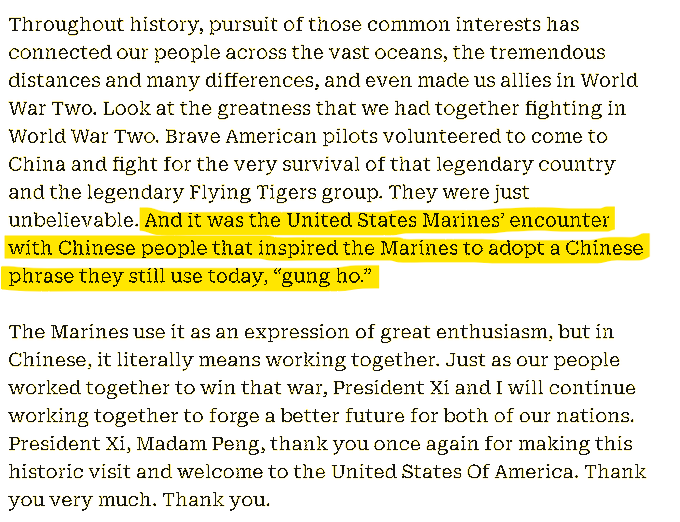
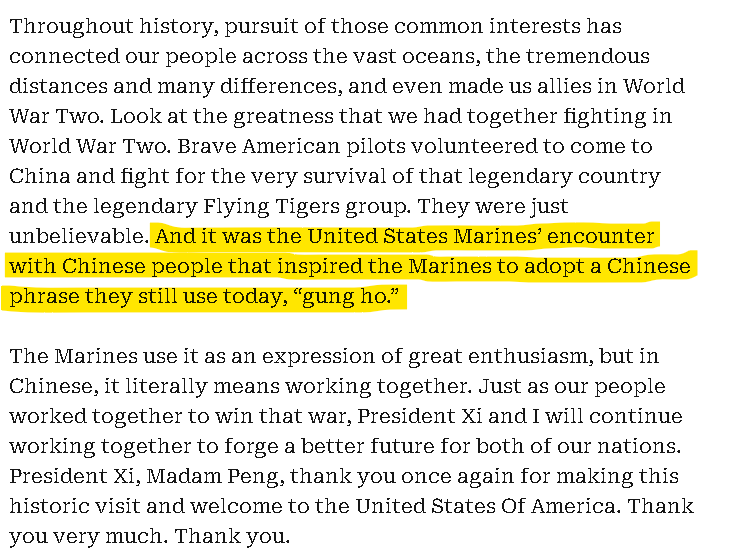
In the English-speaking world, the industrial cooperatives' best known legacy is the term " gung-ho ", which came to mean "overly enthusiastic," but had no relation to its meaning in Chinese, stemming from the shortened name 工合 ( pinyin : gōnghé ; lit. ' industrial cooperative(s) ' ).
History
The Gung Ho ( Chinese : 工合 ; pinyin : gōnghé ; lit. ' industrial cooperative(s) ' ) movement was first initiated in Shanghai in 1937. Some of the principal organizers were Rewi Alley of New Zealand, Edgar Snow , Nym Wales ( Helen Foster Snow ), and Ida Pruitt of the US, as well as a group of Chinese including Hu Yuzhi ( 胡愈之 ) and Sha Qianli ( 沙千里 ). In August 1938, the CICA was established. [ 2 ] It was founded in the wartime capital Hankow when China was engaged in the Second Sino-Japanese War . Through the sponsorship of Madame Chiang Kai-shek , Finance Minister Dr. H. H. Kung supplied government financial support. [ citation needed ]
The movement aimed to organize unemployed workers and refugees, increasing production to support the war effort. The goal was to replace industrial capacity lost to bombing by dispersing and giving workers voting shares in their CICs. The CICA organized small scale self-supporting cooperatives , mainly in rural areas, to create employment for workers and refugees and produce goods for the war effort. [ 3 ]
In January 1939, the international arm ICCIC was established in Hong Kong. Ms. Soong Ching-ling was elected honorary chair and the Anglican Bishop of Hong Kong, the Right Rev. Ronald O. Hall to be chair, and Dr. Chen Hansheng was appointed as secretary general. Rev. Dr. Walter Brooks Foley, pastor of Union Church of Manila, Philippines, serve on the international committee, along with leading Chinese businessmen in Manila Dee C. Chuan, Alfonso Sycip, and Yu Khe thai. Foley became president of the Philippine Association of Chinese Industrial Cooperatives. [ 4 ] [ 5 ]
In 1941, the Gung Ho movement reached its peak: around 3,000 cooperatives with a combined membership of nearly 300,000 people were functioning. [ 6 ] Their factories produced more than 500 products for the local people, and a large number of blankets, uniforms and other army supplies for the battlefront. Ida Pruitt toured the United States to raise substantial financial support. The unique role of Gung Ho cooperatives in the war also won such international acclaim that the term " gung-ho " became a famous slogan of the U.S. Marine Corps . Adopting the literal meanings of the two characters separately as "work" and "together", the slogan entered the English language as a term denoting whole-hearted dedication to a meaningful cause. [ 7 ]
Both the Nationalist government of Chiang Kai-shek and the Communist movement of Mao Zedong supported the movement and tried to control it. Alley placated the Nationalists but his sympathies and eventual loyalties were to the emerging Communist government. In 1942, Alley was dismissed from Gung Ho by the government of Chiang Kai-shek . [ 6 ] After Mao's victory in 1949 Alley stayed in China, but there was no need for the CICA and ICCIC. Both CICA and ICCIC suspended their works in 1952. [ citation needed ]
Graham Peck reports in colorful but analytical detail in Two Kinds of Time He traveled with Alley to a number of CICs early in 1941 and saw them at their height, but he came to understand their limitations and the fact that their course was ultimately downwards, not upwards. [ citation needed ] [ 8 ]
Revival
The CICA was revived in 1983, and the ICCIC was revived in 1987 in Beijing by Alley and other former Gung Ho leaders. [ 6 ] The reorganized ICCIC registered with the Ministry of Civil Affairs of People's Republic of China as an international non-profit organization. Zhu Xuefan ( 朱學範 ) was elected as honorary chair and Alley as chair.
The main task of the revived ICCIC is the promotion of cooperatives in China. Membership is open to all individuals and organizations who support the cooperative movement. The committee has approximately 100 members from China, Australia , Germany , Belgium , France , Japan , Mexico , Singapore , the United Kingdom , the United States of America , and Hong Kong . The ICCIC's General Assembly of all members meets every five years. The executive board elected by the Assembly is responsible for decision-making on major issues according to its articles of association during the adjournment of the Assembly. A secretariat is set up to handle day-to-day work.
See also
Evans Carlson
Helen Foster Snow
Gung-ho
Industry of China
History of the cooperative movement in China
Notes
↑ Bernardi, Andrea; Miani, Mattia (2014-07-03). "The long march of Chinese co-operatives: towards market economy, participation and sustainable development" (PDF) . Asia Pacific Business Review . 20 (3): 330– 355. doi : 10.1080/13602381.2014.931044 . ISSN 1360-2381 . S2CID 154466030 .
↑ "Rewi Alley" . New Zealand China Friendship Society. 2010-01-19 . Retrieved 2010-10-31 .
↑ Anne-Marie Brady , Friend of China: The Myth of Rewi Alley (London; New York: Routledge Curzon, 2002, ISBN 978-0700714933 ): 30-31.
↑ Alley, Rewi (1997). Rewi Alley: an autobiography . New World Press. ISBN 978-7-80005-344-3 . OCLC 48776431 .
↑ "Introduction" . International Committee for the Promotion of Chinese Industrial Cooperatives . Beijing . Retrieved 2010-10-31 .
1 2 3 "International Committee for the Promotion of Chinese Industrial Co-operatives" . New Zealand China Friendship Society . 2010-01-19 . Retrieved 2010-10-31 .
↑ "Introduction of ICCIC" . International Committee for the Promotion of Chinese Industrial Cooperatives . Retrieved 2009-03-17 .
↑ Two Kinds of Time . first edition, Houghton Mifflin (1950);reprint University of Washington Press, 2008. Archived from the original on October 23, 2008.
References
Barnett, Robert W. (1940). "China's Industrial Cooperatives on Trial". Far Eastern Survey . 9 (5): 51– 56. doi : 10.2307/3022292 . JSTOR 3022292 .
King, Marjorie (2006). China's American Daughter: Ida Pruitt (1888-1985) . Hong Kong: Chinese University Press. ISBN 978-9629960575 .
Staff (1941). "Chinese Industrial Cooperatives Marking Time". Far Eastern Survey . 10 (18): 208– 213. doi : 10.2307/3021915 . JSTOR 3021915 .
"New Industries" , Time . 22 April 1940.
External links
ICCIC official website
Inventory of Rewi Alley’s Papers
Albert F. Moe (1967) "Gung Ho", American Speech . The American Dialect Society.
"China Through Western Eyes"
Indusco Inc. records at the Rare Book and Manuscript Library, Columbia University, New York, NY
v
t
e
Consumer
Worker ( list )
Purchasing
Retailer
International Co-operative Alliance
Cooperative wholesale society
Credit union
Mutual savings bank
Savings and loan association
Building society
Building
Cohousing
Student housing
Housing society egalitarian commune
egalitarian
commune
Collective farming
Reforestation
Winemaking
Wheat pool
Community wind energy
Electric
Telephone
Broadband
Health insurance cooperative
Mutual insurance
Independent practice association
Food list
list
Recycling
Platform
Media
Mining
Social services
Friendly society
Agent-owned company
Stokvel
Artel
RT @Rescue_Michigan: An amazing story, full of irony
Really interesting that Trump mentioned the Chinese origin of the term "gung ho" during his remarks at Xi's arrival ceremony 👇 (https://t.co/NB5ydHmC2T) What he didn't mention, however, is the most fascinating fact: it directly comes from an organizational concept that the US Marines borrowed from the Communist Army during WW2. See, during WW2, the Communists were at a big disadvantage versus both the Japanese and Chiang Kai-shek's Nationalists: fewer weapons, less money, no foreign backing to speak of. Yet they kept proving extraordinarily capable, scoring many victories, and an American Marine officer named…
Read full post
Evans Carlson (https://t.co/MTNtQZDskj) decided to embed himself with the Eighth Route Army (the Communist forces under Zhu De) in order to understand why. What he found - which deeply impressed him - was a completely different organizational culture to traditional armed forces: almost no hierarchy, officers sharing the same food and hardships as the men, open discussion of objectives, and discipline based on conviction rather than rank. In short, the Communists' secret weapon was cohesion - the way they worked together - and Carlson came away convinced it was the model for how fighting units should be run. He didn't quite know how to call this organizational concept so he borrowed a term from a Chinese cooperative movement he'd come across during his travels (the Chinese Industrial Cooperatives: https://t.co/abEo7GCetn), known by the abbreviation 工合 (gōnghé) which literally means "work together". It captured exactly what he'd seen in the Eighth Route Army. Back in the Marines he took command of the 2nd Marine Raider Battalion ("Carlson's Raiders") in 1942, and he adopted "Gung Ho" as the unit's motto and applied the Eighth Route Army model. He held "Gung Ho meetings" where rank was set aside and men could speak freely and criticise, officers had no special privileges, and everyone was expected to understand why they were fighting. The Raiders became famous for the Makin Island raid (August 1942) and the "Long Patrol" on Guadalcanal (late 1942). Carlson's Marine unit became so legendary that Hollywood made the 1943 film Gung Ho! about them (https://t.co/GeSCG9Sk3I!), which is largely how the phrase spread into general American English. So there you have it, many ironies here, first among which is the fact that the US Marines learned to let their men speak freely and criticize their leaders by... watching the Chinese Communists 😊
Original title: Chinese Industrial Cooperatives - Wikipedia
Samuel Times preserves the original link so every selection remains auditable.