Vitalik Buterin outlines Ethereum’s cryptographic world computer vision
The cryptographic world computer We talk about Ethereum as "a blockchain", as though it is fundamentally the same technology as the Bitcoin that Satoshi Nakomoto created back in 2009. In many ways it is, and in some ways even the "lean Ethereum" of the future that is being built along the lines of the Strawmap retains the core trappings of a blockchain.…

The cryptographic world computer
The cryptographic world computer
We talk about Ethereum as "a blockchain", as though it is fundamentally the same technology as the Bitcoin that Satoshi Nakomoto created back in 2009. In many ways it is, and in some ways even the "lean Ethereum" of the future that is being built along the lines of the Strawmap retains the core trappings of a blockchain. But at the same time, the technology has evolved greatly over the last fifteen years, and is poised to evolve even more over the next three - to the point where it becomes fair to call the thing that Ethereum is moving towards a qualitatively different kind of system.
The Ethereum of today has general-purpose computation, proof of stake, onchain applications using zero-knowledge proofs and L2s that provide scaling and privacy. The Ethereum of tomorrow will have computation with a tunable dial between extreme scale and full generality, multiple forms of multi-participant block construction, a highly optimized form of proof of stake, and zero-knowledge proofs baked in playing key roles at the base layer.
This post will walk through some of the most important fundamental differences between blockchains in 2010 and blockchains in 2030, both from the point of view of the technology and from the point of view of what properties you can expect to have as a user.
To start off, let's go through the original Bitcoin whitepaper, section by section, and see how this compares to Ethereum - in 2015 ( yellow ), 2025 ( green ) and 2030 ( blue ).
There are large changes to basically every section. To make things more compact, let's make it a table:
Pretty much every core property of what it means to be a blockchain either has fundamentally changed or soon will fundamentally change:
Verification : download and re-execute → PeerDAS sample and verify a SNARK
Consensus : PoW → PoS → much better optimized PoS
Block construction authority : single miner makes block → multi-party block construction
As an AI might say, the only honest conclusion (ok fine, the honest punchline ) is that a modern cryptographic network like the post-Lean-upgrade Ethereum is called a "blockchain" to a large extent for historical reasons. In reality it's a hybrid construction that merges together two strands:
Core Satoshian ideas
New powerful cryptographic machinery that emerged out of 50 years of academia and did not even exist (or was not mature) in 2009
How much crypto is in crypto? 2009 vs 2020 vs 2030
Cryptography is not the only science that matters. Also important are: formal verification , database theory, improvements in peer-to-peer networking theory, information theory, economics and much more. But all of these things are compatible with the fundamental core of "everyone tries to make the next block with valid PoW, one guy succeeds, broadcasts it, everyone else downloads it and re-executes, repeat". The cryptographic changes are not.
Now, what does this mean for users?
The most important conclusion is that the set of tradeoffs for users is radically changing:
When building applications, structure of computation is starting to matter a lot. In a simple blockchain, 1 byte = 1 byte and 1 gas = 1 gas. In the architectures of the future, the same amount of computation will cost you much more if you shove it all into one inscrutable serially-executed transaction, and much less if you put it into well-encapsulated dependencies that can be parallelized or pruned, ideally before the transaction even enters the final block. This affects the incentives of developers, and will over time affect the structure of all applications using Ethereum: perhaps in the long run, we will converge toward programming patterns where information directly related to describing non-commutative state changes and ordering is posted onchain, and everything else is aggregated before it even gets included into a block .
Structuring computation lets the blockchain more effectively focus on its job.
Perhaps the most important shift is that the decentralized nature of the network is shifting from being purely a burden incurred in the name of safety and robustness to at least sometimes, in a few limited cases, being a strength even from a performance perspective . The decentralized network allows larger volumes of data to be stored in parallel. It allows a high volume of computation to happen in parallel, in many cases inside the mempool. In a few cases, it increases privacy, because only decentralized networks can effectively hide metadata (eg. where data and requests are coming from ).
Back in the mid-2010s, this was an early dream of Ethereum: that we could decentralize not just for robustness but also to increase scale. If centralized systems can split up work between different participants to increase their performance, so should we. Back then, this was not viable for one primary reason: the missing ingredient was verification . If you split up work, you have to verify that each unit of work was done correctly. Early designs attempted to patch this with randomly sampled committees, but they all ran into the same bottleneck: first, committees are complicated to set up and expensive and greatly increase latency, second, there is no recourse if the committee fails. Now, with modern cryptography, this problem is solved, and the overhead factor of that solution is decreasing month by month.
Another area to watch for where decentralization can potentially improve performance properties is latency. Ethereum itself will never have latency that competes with servers, but infrastructure built around it could.
In general, creating a stronger decentralized layer in the middle between users and a chain, that is not itself a chain, could make Ethereum very powerful without compromising any of the chain's fundamental properties.
Later in the future, there is the possibility that Ethereum will go through one further shift - the possible rise of obfuscation (iO). The holy grail here is that viable obfuscation can eliminate the tradeoff between privacy and generalization: you can have fully generalized computation involving an unbounded number of (asynchronous) participants in a fully secure and encrypted form. Even weak versions of obfuscation have many applications in eg. encrypted mempools. But all of the conclusions in this post will apply long before any of that becomes available.
This is the "cryptographic world computer": a shift from Ethereum as solely a ledger onto which you can indiscriminately dump computation and data that gets executed, to an architecture that combines blockchains with cryptographic privacy and verification, and powerful decentralized off-chain components.
There are still many challenges in fully building out this design. Making zero knowledge proofs efficient enough and safe enough is difficult, but it is encapsulated complexity and is already being heavily optimized with AI tools. The more difficult, and systemically complex, piece will likely be managing and parallelizing access to very large amounts of state. There are already many ideas on the horizon for how to handle this, though they need to be refined especially as we learn more about what applications will be running in the future.
If you look at the Strawmap , Hegota - the fork planned for next year - is likely to be Ethereum's last "normal" fork, with features and technology that would be recognizable to someone in 2015. Everything after that involves recursive STARKs, automated formal verification, highly optimized consensus algorithms, and making it all quantum-safe. With PeerDAS, Ethereum began its transition from being just a blockchain to being something much more powerful. Starting after Hegota, this transformation becomes Ethereum's primary story . The final outcome of this: much more cheap, scalable and private high-security computation than anything that could be done with the previous era's technology alone. The cryptographic world computer.
RT @hoprnet: Ethereum wants network-layer privacy, we know a thing or two about that

Cool to see iO get some love — @AnnaRRose and I did a podcast with the iO 🐐 Rachel Lin that does conceptualizes its promise + challenges My favorite applications of iO is Zhandry's Quantum Lightning — the most secure, post-quantum decentralized currency design IMO
The cryptographic world computer: https://t.co/LF2JGU38Rx My attempt to express in somewhat concise terms the true meaning of basically everything planned to happen to Ethereum starting from the fork after Hegota. It's really not just a blockchain anymore. It's a hybrid architecture that combines together blockchains and modern cryptography, to enable much…
Read full post
more powerful properties. FOCIL, EIP-8288, Lean consensus, state management, formal verification, advanced mempool improvements (including privacy), and the longer-term specter of obfuscation all mentioned.
RT @zengjiajun_eth: the blockchain version of “world computer” excite me no more. It’s just not that useful for the mass, it’s actually u…
RT @StaniKulechov: There are countless of use-cases where Ethereum verifiability would be useful beyond smart contact execution environment…
RT @VitalikButerin: The cryptographic world computer: https://t.co/ueayODeUPo My attempt to express in somewhat concise terms the true me…
RT @cryptographicas: Ok I just read through vitalik’s paper and if the vision he outlined is executed the implications are absolutely insan…
Ethereum is undervalued. Fuck what broccoli hair kids think
The cryptographic world computer: https://t.co/LF2JGU38Rx My attempt to express in somewhat concise terms the true meaning of basically everything planned to happen to Ethereum starting from the fork after Hegota. It's really not just a blockchain anymore. It's a hybrid architecture that combines together blockchains and modern cryptography, to enable much…
Read full post
more powerful properties. FOCIL, EIP-8288, Lean consensus, state management, formal verification, advanced mempool improvements (including privacy), and the longer-term specter of obfuscation all mentioned.
Ok I just read through vitalik’s paper and if the vision he outlined is executed the implications are absolutely insane especially for the app layer. The paper is basically Eth’s plan on how they will enable computation off chain with Eth verifying the result (ensuring computation occurred and what it did etc etc). Now what this means is the definition of “onchain” itself changes, because instead of every part of an app having to execute inside a smart contract you can push a huge amount of complexity elsewhere and still inherit ethereum’s guarantees, this really does open up a huge amount of design space…
Read full post
especially for DeFi. For example with lending you could have really sophisticated systems analysing collateral, liquidity, borrower behaviour and market conditions offchain, with multiple solvers or execution systems competing to produce the best outcome, like the cheapest liquidation route, best refinancing rate, best collateral swap or best way to match borrowers and lenders all while the protocol only accepts outcomes that satisfy its rules. So basically a lot more of the smart stuff behind a financial product can happen outside the smart contract, while Eth still acts as the final layer that checks the rules were followed and makes sure the money moves exactly as it should. The MEV implications here are quite interesting too because more economic activity happening before settlement means more value moves upstream into who gets the information first, who computes the best outcome and what gets presented to Eth. But the thing I’m most bullish on is what this does to the TAM of Eth just because this vision means ethereum doesn’t have to be fast enough to do everything itself it just has to be able to verify everything that matters. And that’s an enormous difference. It’s literally a world computer.
The cryptographic world computer: https://t.co/LF2JGU38Rx My attempt to express in somewhat concise terms the true meaning of basically everything planned to happen to Ethereum starting from the fork after Hegota. It's really not just a blockchain anymore. It's a hybrid architecture that combines together blockchains and modern cryptography, to enable much…
Read full post
more powerful properties. FOCIL, EIP-8288, Lean consensus, state management, formal verification, advanced mempool improvements (including privacy), and the longer-term specter of obfuscation all mentioned.
one question this line of thinking has been raising for me --is "tokenization" even a necessary thing? in its fully custodial, centralized, reversible, freezable, censorable version, I think there is a growing case for 'no' consider eg stablecoins--why don't they just prove a bunch of facts about $ value of reserves and claims against those reserves, instead of having a 'coin'? I think you only need a coin/token if you are trying to give the asset at least partial bearer-asset properties--which would mean the issuer has some kinds of constraints on freezing it, reversing transactions in it, etc. vs the…
Read full post
asset being arbitrarily censorable. . . then it makes sense to hold the asset in a wallet on a separate ledger the asset-issuer does not control; otherwise you can just rely on proofs about the state of the asset-issuer's ledger...
The cryptographic world computer: https://t.co/LF2JGU38Rx My attempt to express in somewhat concise terms the true meaning of basically everything planned to happen to Ethereum starting from the fork after Hegota. It's really not just a blockchain anymore. It's a hybrid architecture that combines together blockchains and modern cryptography, to enable much…
Read full post
more powerful properties. FOCIL, EIP-8288, Lean consensus, state management, formal verification, advanced mempool improvements (including privacy), and the longer-term specter of obfuscation all mentioned.
RT @VitalikButerin: The cryptographic world computer: https://t.co/ueayODeUPo My attempt to express in somewhat concise terms the true me…
long ETH
The cryptographic world computer: https://t.co/LF2JGU38Rx My attempt to express in somewhat concise terms the true meaning of basically everything planned to happen to Ethereum starting from the fork after Hegota. It's really not just a blockchain anymore. It's a hybrid architecture that combines together blockchains and modern cryptography, to enable much…
Read full post
more powerful properties. FOCIL, EIP-8288, Lean consensus, state management, formal verification, advanced mempool improvements (including privacy), and the longer-term specter of obfuscation all mentioned.
RT @TziokasV:
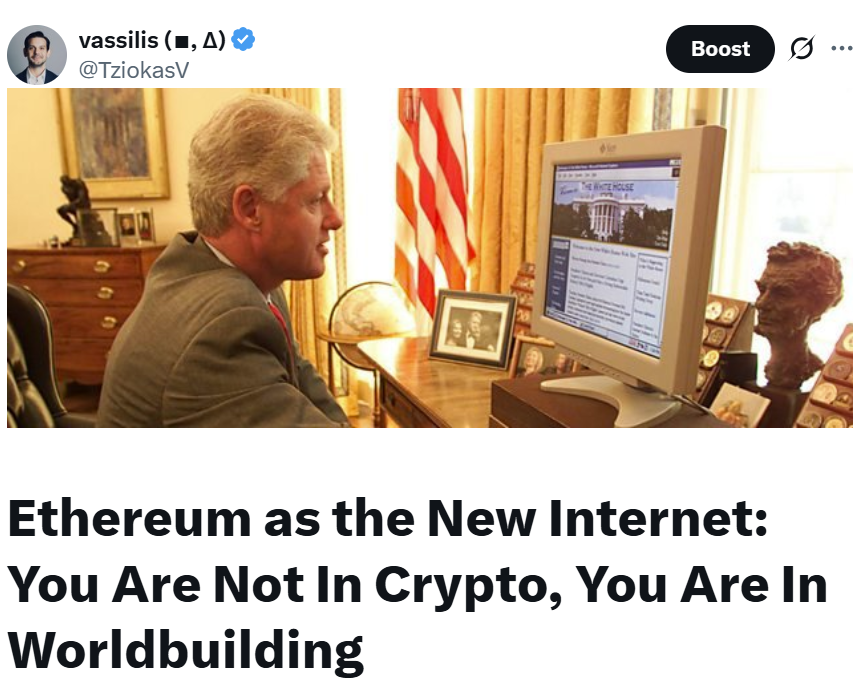
that’s literally my quant 🫶
The cryptographic world computer: https://t.co/LF2JGU38Rx My attempt to express in somewhat concise terms the true meaning of basically everything planned to happen to Ethereum starting from the fork after Hegota. It's really not just a blockchain anymore. It's a hybrid architecture that combines together blockchains and modern cryptography, to enable much…
Read full post
more powerful properties. FOCIL, EIP-8288, Lean consensus, state management, formal verification, advanced mempool improvements (including privacy), and the longer-term specter of obfuscation all mentioned.
RT @VitalikButerin: The cryptographic world computer: https://t.co/ueayODeUPo My attempt to express in somewhat concise terms the true me…
Really feels like the aspirational version of what Ethereum can be is within our grasp. Psyched to read this new paper from Vitalik!
The cryptographic world computer: https://t.co/LF2JGU38Rx My attempt to express in somewhat concise terms the true meaning of basically everything planned to happen to Ethereum starting from the fork after Hegota. It's really not just a blockchain anymore. It's a hybrid architecture that combines together blockchains and modern cryptography, to enable much…
Read full post
more powerful properties. FOCIL, EIP-8288, Lean consensus, state management, formal verification, advanced mempool improvements (including privacy), and the longer-term specter of obfuscation all mentioned.
Original title: The cryptographic world computer
Samuel Times preserves the original link so every selection remains auditable.